


Why Your Own References
Permissions, model release forms, and the simple camera setup Maddy relies on.
MasterDemos
If you're a student you can get 30% off with code STUDENTARTIST and your school email.


Discover the stories behind Maddy's Western oil paintings
Watch as Maddy paints in her signature realistic impressionist style and creates work that reads as real life while remaining loose and painterly.
In this course she takes a raw panel all the way to a finished painting over 50 lessons, covering her priming method, her sketchbook warmups, and the color studies behind her muted palette.


Maddy walks through her studio setup, from the supplies on her table to priming a raw panel.

Maddy shares the rural upbringing and the themes of heritage and grit that led her to paint Western subjects.

Maddy walks through her essential supplies, including neutral gray palette paper, a sealed palette box, gloves, and an air filter.

Maddy explains why she uses safflower oil as her medium and demonstrates her system for keeping solvent clean and reusable.

Maddy explains why acrylic gesso dulls oil paint and demonstrates applying oil ground thickly to build surface texture.

Maddy compares flat, bright, filbert, and round brushes and shows how each one marks paint differently.

Maddy fills a sketchbook page with longhorns, drawing the shapes she sees rather than the ones she expects.

Maddy explains why drawing is the foundation of her paintings and introduces the warmup studies she works from her own reference photos.

Maddy draws a longhorn using only the shapes she can see, rather than what she assumes should be there.

Maddy sketches a second longhorn while catching the mind's tendency to fill in details that are not actually visible.

Maddy demonstrates how a calf's facial structure differs from an adult's, with wider eyes, larger ears, and a much shorter face.

Maddy uses negative space to check her proportions and shows how she dates and annotates each finished sketchbook page.

Maddy breaks down her eleven color palette and the studies that shaped it.

Maddy explains chroma and limited palettes, and why the pigment codes on a tube matter more than the color name.

Maddy lays out her eleven colors in the same order she uses every session and explains why black never appears on her palette.

Maddy compares two tubes of olive green from different brands to show how much the pigment choice changes a color.

Maddy tints each color on her palette to reveal its true temperature and to find which ones turn chalky when lightened.

Maddy begins a color study of yellow ochre, mixing it against each of the reds, purples, and yellows on her palette.

Maddy completes the study through the greens, blues, and grays, revealing which combinations turn unexpectedly gray.

Maddy compares her original sixteen color palette to the eleven she uses now and explains why fewer colors produce better results.

Maddy shares her favorite books on animal anatomy, oil technique, composition, and color theory.

Maddy selects her reference, sets the composition, and settles every value before touching the panel.

Maddy explains what makes a reference worth painting and why she chose this one photo out of roughly three hundred.

Maddy demonstrates how to match a reference crop to the panel's aspect ratio before committing to a composition.

Maddy tones the primed panel with thinned paint so her values can be judged accurately from the first stroke.

Maddy explains why value determines where a viewer looks, then mixes a mid tone against the neutral gray of her palette.

Maddy places her darkest darks first and steps up through each value, keeping the early layers thin.

Maddy switches to a smaller brush to frame the legs and push shadows beyond what the reference actually shows.

Maddy blurs her eyes to find what stands out first, then rebalances the composition around the two faces.

Maddy sketches a deliberately loose drawing inside a two by two grid and seals it with acrylic setting spray.

Maddy mixes every color she needs, then blocks the whole painting in across one long session.

Maddy builds a warm black from five colors and demonstrates how she dulls any mixture with its complement.

Maddy mixes her neutral whites, a dull purple, and a warm brown for reflected ground light, then settles on a background color.

Maddy lays the first paint on the panel, working outward from the hindquarters in the direction the muscles run.

Maddy adds the transition values between shadow and light, then introduces the dry brush she uses to soften edges.

Maddy keeps the calf lighter than the reference shows so the cow remains the dominant subject.

Maddy paints both horns in a single pass so they match, then places the eye by comparing it to the surrounding landmarks.

Maddy warms a painting that has gone too cool and explains when to stop working wet paint entirely.

Maddy demonstrates her mirror trick for catching the anatomical errors her eye has stopped noticing.

Maddy applies the background in thick dollops, then deliberately softens every hard edge with a dry brush.

Maddy returns to the dry painting to build detail and texture, then signs it.

Maddy shows how she keeps mixed paint fresh between sessions, then remixes the warm and light colors the painting still needs.

Maddy corrects the eyelash placement, warms the nose, and builds the small shapes of a young face.

Maddy adds highlights, fluffs the ears with a dry brush, and taps mud onto a set of gangly legs.

Maddy builds the cow's front leg from anchors, transition shadows, tendon highlights, and dew claws.

Maddy drags light paint across dry texture and emphasizes the hip bone that completes the composition's arch.

Maddy layers blues and warms into the darks while keeping the edge of every spot deliberately broken.

Maddy loads a rough filbert with black and presses it into the panel to create the look of hair mid swish.

Maddy softens the rear leg into the distance while bringing the front leg forward with added contrast.

Maddy covers the remaining pencil marks and taps in the folds that run along the neck and back.

Maddy paints the growth rings near the head and keeps the horns warm, since they carry a great deal of blood.

Maddy builds the sideways pupil, the water line, and the eyelash while keeping the eye from looking unnatural.

Maddy creates the illusion of a nostril rather than a flat shape and hints at whiskers too fine to actually see.

Maddy explains why dark passages sink as they dry and covers oleo gel as an alternative to varnishing early.

Maddy smears existing paint with a small knife to catch the light and brightens the outer corners into a vignette.

Maddy taps grass in multiple directions and pulls it up over the hooves to ground the animals in the scene.

Maddy tests her signature placement, keeps it low in contrast, and explains how she varnishes once the surface is fully dry.

Comprehensive workbook with key insights and exercises from Maddy's course

Maddy's complete course on gathering reference photos, included at no extra cost.
As a special launch promotion, this entire course is included with your purchase at no extra cost.
Maddy shows you how she finds, photographs, and selects the reference photos behind her paintings. You will spend a day in the field with her, then sit down at the computer as she sorts through everything she brought home.
The two courses connect directly. The reference photo of the cow and calf that Maddy paints in this course was captured on camera during the longhorn shoot in Part 3, and you will watch her choose it out of roughly three hundred photos.

Permissions, model release forms, and the simple camera setup Maddy relies on.

Shooting a place she has photographed her whole life and still finds something new in.

Working the light around a live herd at Wayment Longhorns in Honeyville, Utah.

Culling a full shoot at the computer, plus storage, backups, and why it all matters.


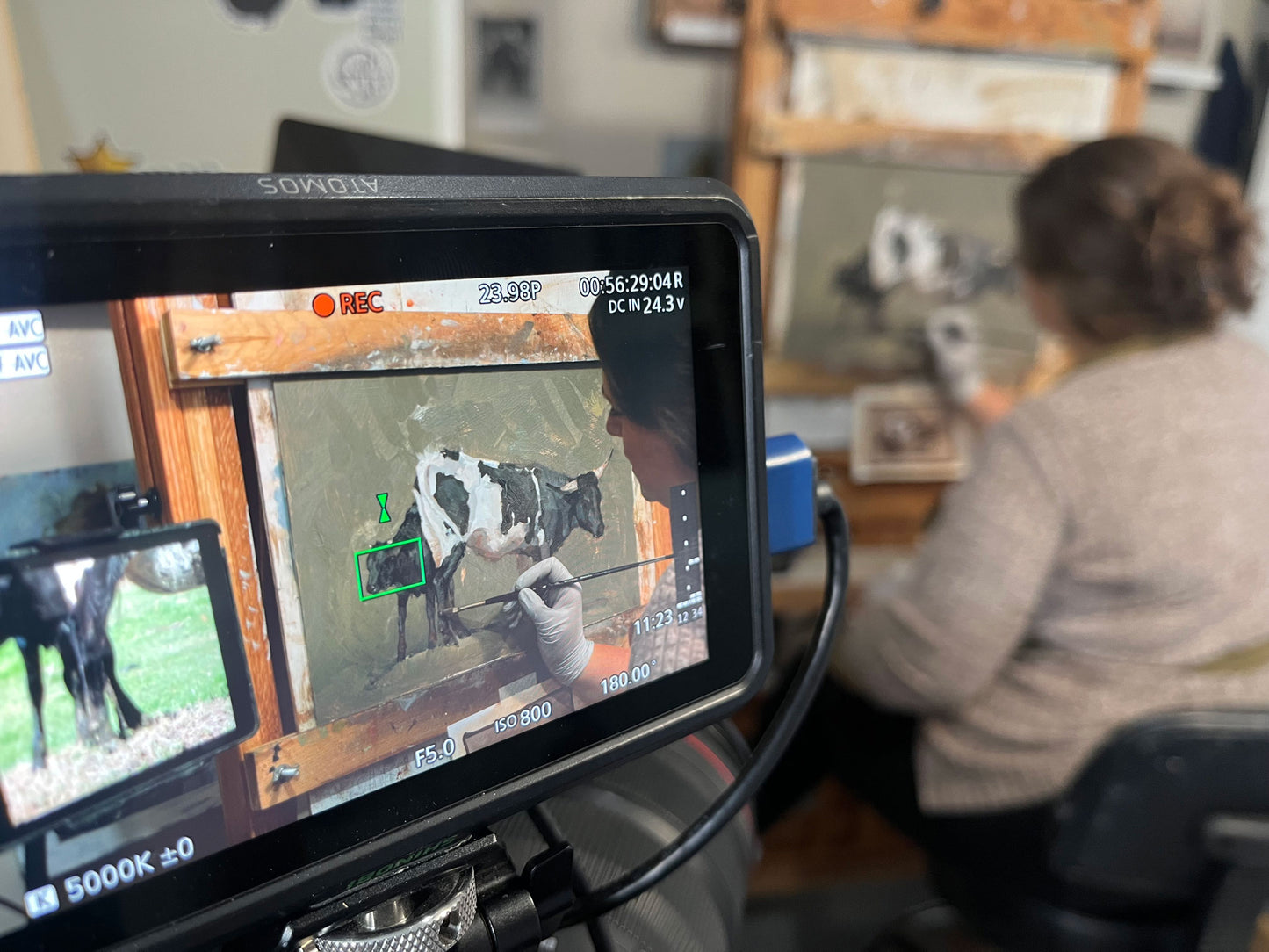

Madelynn Mutter is a Western artist known for capturing the grit and quiet moments of rural American life in oil. She calls her style realistic impressionism, building paintings from thick paint, soft edges, and a deliberately muted palette that feel true to the ranches and families they come from.


